Key points
- Condo rents are quoted per month. URA publishes medians in dollars per square foot per month for each development.
- Prime districts 9, 10 and 11 and the downtown districts command the highest rents per square foot.
- The minimum lease for a private home is three consecutive months. Most leases run one or two years.
- Expect a deposit of one month’s rent per year of lease, plus stamp duty of 0.4% of the total rent.
- Rents rose sharply in 2022 and 2023 and have been broadly stable since.
Singapore has a large, transparent condo rental market. Every tenancy is stamped with IRAS, and URA publishes the resulting rent data each quarter, so tenants and landlords can both see what units are really letting for.
What condos rent for
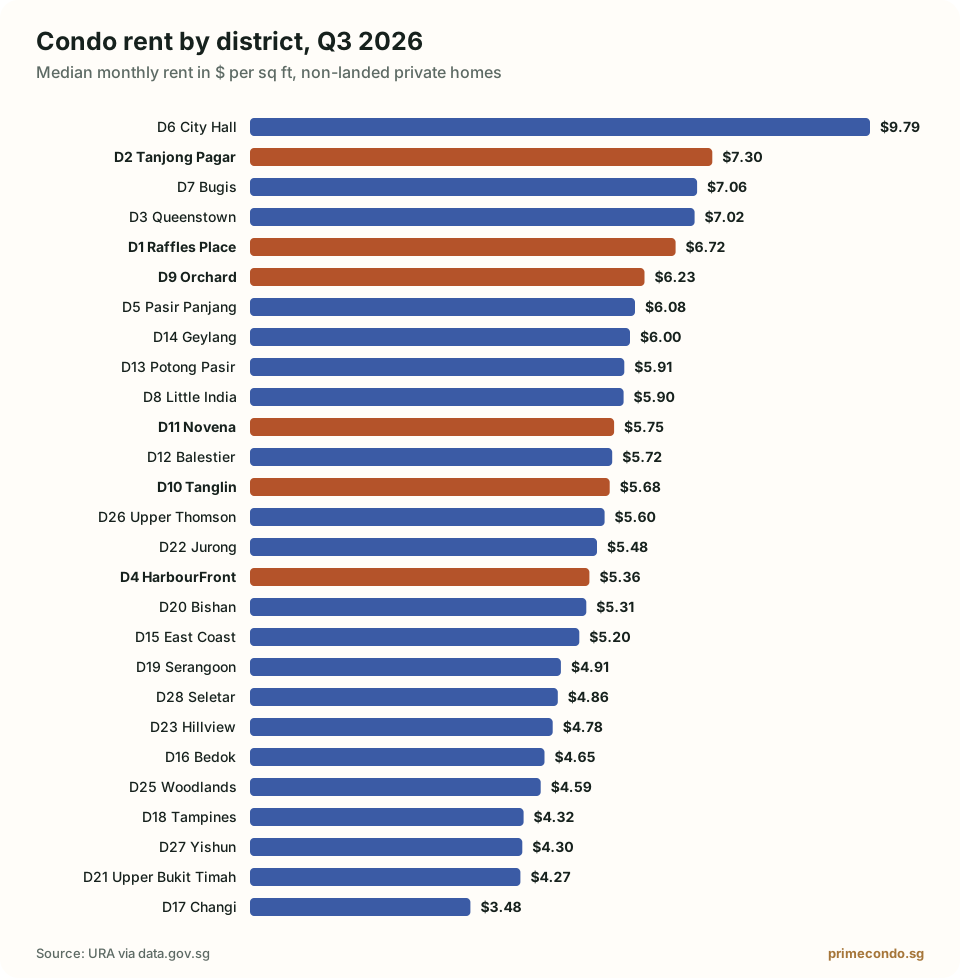
In Q3 2026, the median rent across the 743 developments in URA’s published data was $5.53 per square foot per month. The most expensive district was District 6 (City Hall & High Street) at $9.79, and the least expensive was District 17 (Changi & Loyang) at $3.48.
To turn a per-square-foot figure into a monthly rent, multiply by the floor area:
| District | Median $ psf / month | 500 sq ft (1-bed) | 800 sq ft (2-bed) | 1,200 sq ft (3-bed) |
|---|---|---|---|---|
| D6 City Hall & High Street | $9.79 | $4,900 | $7,850 | $11,750 |
| D2 Tanjong Pagar & Anson | $7.30 | $3,650 | $5,850 | $8,750 |
| D7 Bugis & Beach Road | $7.06 | $3,550 | $5,650 | $8,450 |
| D3 Queenstown & Tiong Bahru | $7.02 | $3,500 | $5,600 | $8,400 |
| D1 Raffles Place & Marina Bay | $6.72 | $3,350 | $5,400 | $8,050 |
| D9 Orchard & River Valley | $6.23 | $3,100 | $5,000 | $7,500 |
| D5 Pasir Panjang & Clementi | $6.08 | $3,050 | $4,850 | $7,300 |
| D14 Geylang, Paya Lebar & Eunos | $6.00 | $3,000 | $4,800 | $7,200 |
| D13 Potong Pasir & MacPherson | $5.91 | $2,950 | $4,750 | $7,100 |
| D8 Little India & Farrer Park | $5.90 | $2,950 | $4,700 | $7,100 |
| D11 Novena & Newton | $5.75 | $2,900 | $4,600 | $6,900 |
| D12 Balestier & Toa Payoh | $5.72 | $2,850 | $4,600 | $6,850 |
These are estimates. Smaller units usually rent for more per square foot than larger ones, so a one-bedroom unit will often be above the district median and a three-bedroom below it. Look up individual developments on the condo rental prices page.
Where rents are heading
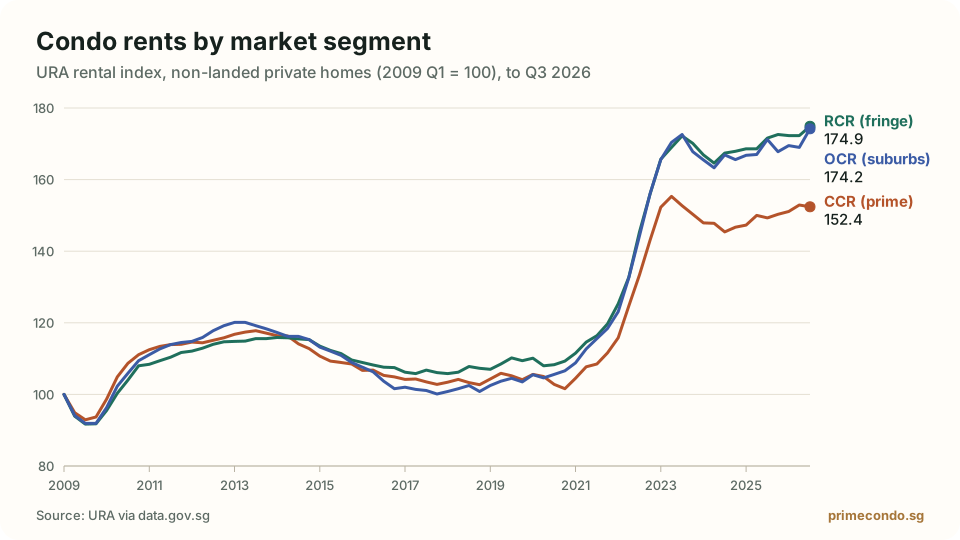
Rents climbed steeply through 2022 and 2023 as borders reopened and construction delays squeezed supply. A wave of completions since then has steadied the market. Over the year to Q3 2026, the URA rental index for condos moved by +1.9%.
The leasing process
- Search and view. Most listings are on the major property portals. Check that any agent you deal with is on the CEA public register.
- Letter of Intent (LOI). You set out your offer: rent, lease term, start date and any requests, such as extra furniture. It is normally accompanied by a good-faith deposit of one month’s rent.
- Tenancy Agreement (TA). Once the landlord accepts, both sides sign the tenancy agreement, usually within a week. You pay the balance of the security deposit and the first month’s rent.
- Stamp duty. The tenant pays stamp duty on the lease within 14 days of signing.
- Handover. Go through the inventory list with the landlord or agent and photograph any existing defects.
Costs for tenants
- Security deposit: by convention one month’s rent for each year of the lease. It is refunded at the end, less any deductions for damage.
- Advance rent: the first month, paid on signing.
- Stamp duty: 0.4% of the total rent for the lease period, for leases of up to four years. On a two-year lease at $5,000 a month, that is 0.4% × $120,000 = $480.
- Utilities and internet: usually set up and paid by the tenant.
- Minor repairs: many agreements make the tenant responsible for repairs up to a set amount per item.
Rules to know
- Minimum stay: three consecutive months.
- Occupancy cap: six unrelated people per home, or eight in homes of 90 square metres or more until 31 December 2026.
- Diplomatic clause: on leases of more than a year, tenants commonly negotiate the right to end the lease after 12 months with two months’ notice if they are transferred out of Singapore.
- Subletting: only with the landlord’s written consent.
For landlords
Before you set a rent, check the median and the 25th to 75th percentile range for your own development on the rental prices page. Then work out your net return after property tax at non-owner-occupier rates, maintenance fees, agent commission and income tax on the net rent.
Frequently asked questions
How much does it cost to rent a condo in Singapore?
It depends on district and size. Multiply the median rent per square foot for the development or district by the unit’s floor area. A 700 sq ft two-bedroom unit at $6.00 per sq ft rents for about $4,200 a month.
Can foreigners rent a condo in Singapore?
Yes. Any foreigner with a valid pass to stay in Singapore, such as an Employment Pass, S Pass, Dependant’s Pass or Student’s Pass, can rent private property. Landlords must check the tenant’s immigration status.
What is the minimum rental period for a condo?
Three consecutive months. Short-term lets of less than three months are not allowed in private residential property.
Who pays the agent’s commission?
Each side normally pays its own agent. Commission is negotiable and there is no fixed rate. One agent cannot collect commission from both landlord and tenant in the same transaction.
How many people can live in a rented condo?
URA caps occupancy at six unrelated people. For larger homes of at least 90 square metres, up to eight unrelated people are allowed until 31 December 2026.
Sources
- URA: Renting property
- IRAS: Stamp duty for leases
- data.gov.sg: Rentals of non-landed residential buildings, quarterly
This guide is general information, not tax, legal or financial advice. Rules change; check the official source before you commit.
Keep reading
Property tax in Singapore for condo owners
Annual value explained, both rate tables, and what a typical condo owner or landlord pays each year.
MarketCCR, RCR and OCR explained: Singapore’s three property regions
Which districts are prime, city fringe or suburban, and how prices in each have moved since 2009.
BuyingCan foreigners buy property in Singapore?
What foreigners can buy, the 60% ABSD, who is exempt under free trade agreements, and how loans work.