Key points
- Property tax is charged every year on a home’s annual value, which is its estimated yearly rent.
- Homes you live in are taxed at 0% to 32%. Homes that are rented out or vacant are taxed at 12% to 36%.
- The first $12,000 of annual value is tax-free for owner-occupiers.
- You can only claim owner-occupier rates on one home.
- The bill arrives at the end of each year and is payable by 31 January.
Property tax is the main recurring tax on owning a home in Singapore. It is separate from income tax and from the stamp duties you pay when buying.
How it is calculated
Property tax = annual value × tax rate
The annual value (AV) is IRAS’s estimate of what your home would rent for over a year, excluding furniture and maintenance fees. It is the same whether you live in the home, rent it out or leave it empty. IRAS reviews AVs every year in line with market rents.
You can find the AV of your property on your property tax bill or through the IRAS myTax Portal.
Property tax rates
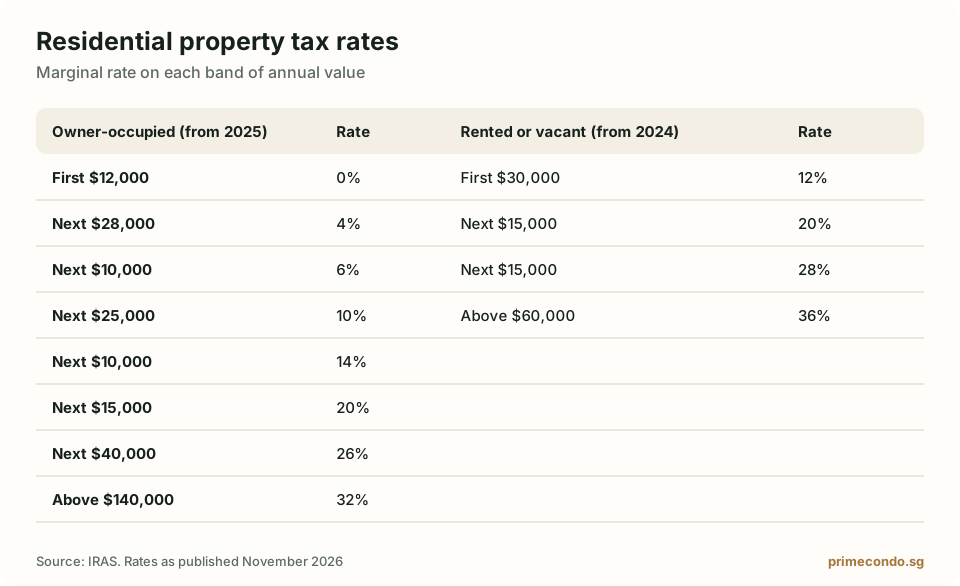
Owner-occupied homes (from 1 January 2025)
| Annual value | Rate | Tax at top of band |
|---|---|---|
| First $12,000 | 0% | $0 |
| Next $28,000 | 4% | $1,120 |
| Next $10,000 | 6% | $1,720 |
| Next $25,000 | 10% | $4,220 |
| Next $10,000 | 14% | $5,620 |
| Next $15,000 | 20% | $8,620 |
| Next $40,000 | 26% | $19,020 |
| Above $140,000 | 32% |
Non-owner-occupied homes (from 1 January 2024)
| Annual value | Rate | Tax at top of band |
|---|---|---|
| First $30,000 | 12% | $3,600 |
| Next $15,000 | 20% | $6,600 |
| Next $15,000 | 28% | $10,800 |
| Above $60,000 | 36% |
Worked examples
A condo you live in, AV $48,000
- First $12,000 at 0% = $0
- Next $28,000 at 4% = $1,120
- Remaining $8,000 at 6% = $480
- Tax: $1,600 a year
The same condo rented out, AV $48,000
- First $30,000 at 12% = $3,600
- Next $15,000 at 20% = $3,000
- Remaining $3,000 at 28% = $840
- Tax: $7,440 a year
Renting out the same unit more than quadruples the tax. Landlords should include it when working out net yield.
A prime condo you live in, AV $120,000
- Tax at the top of the $100,000 band = $8,620
- Remaining $20,000 at 26% = $5,200
- Tax: $13,820 a year
Who qualifies for owner-occupier rates
You must own the home and live in it. Owner-occupier rates apply to one property only, and a married couple shares that one. If you move out and let the unit, tell IRAS, because the higher rates apply from the date it stops being owner-occupied.
When to pay
IRAS sends the bill for the coming year in November or December. Payment is due by 31 January. You can pay in monthly interest-free instalments by GIRO.
When a property changes hands, the lawyers apportion the year’s tax between seller and buyer at completion.
Property tax and your rental return
For a landlord, property tax comes off the top of the rent, along with maintenance fees, agent commission, insurance and income tax on the net rent. See what condos rent for by district and our guide to renting a condo in Singapore.
Frequently asked questions
How is annual value calculated?
IRAS estimates the gross annual rent the property could fetch if it were rented out, excluding furniture, furnishings and maintenance fees. It is based on market rents of comparable properties, not on what you actually charge.
Do I pay property tax if my condo is empty?
Yes. A vacant home is taxed at the non-owner-occupier rates of 12% to 36%.
Is property tax the same as stamp duty?
No. Stamp duty is a one-off tax when you buy or sell. Property tax is an annual tax on ownership.
Can a married couple claim owner-occupier rates on two homes?
No. A married couple can only claim owner-occupier tax rates on one residential property between them.
Sources
This guide is general information, not tax, legal or financial advice. Rules change; check the official source before you commit.
Keep reading
Buyer’s Stamp Duty (BSD) in Singapore: rates and how to calculate it
The six BSD bands, a shortcut formula, and exactly how much duty applies from $1 million to $5 million.
RentingRenting a condo in Singapore: prices, rules and process
Median rents by district from URA data, and how the leasing process works from letter of intent to handover.
FinancingHow much condo can I afford in Singapore?
How banks work out your maximum loan, and how much cash and CPF you need at each price.