Key points
- Every buyer pays BSD, whatever their nationality or number of properties.
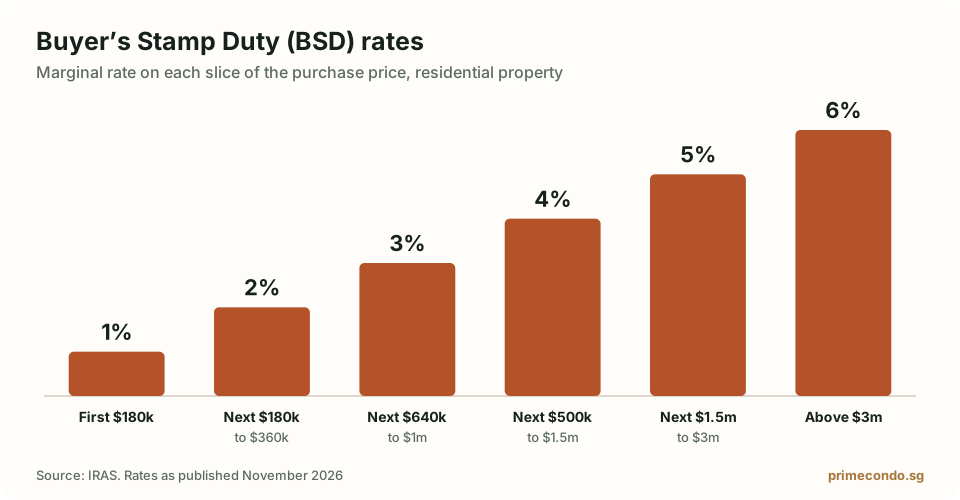
- Residential rates run from 1% on the first $180,000 to 6% on anything above $3 million.
- BSD is charged in bands on the purchase price or market value, whichever is higher.
- It is due within 14 days of signing the contract.
- Shortcut for homes between $1.5 million and $3 million: 5% of the price minus $30,400.
Buyer’s Stamp Duty (BSD) is the one property tax every buyer in Singapore pays. It applies to every purchase of a home, with no exemption for first-timers. The current residential rates have applied since 15 February 2023.
BSD rates for residential property
| Slice of the price | Rate | Duty on this slice |
|---|---|---|
| First $180,000 | 1% | $1,800 |
| Next $180,000 | 2% | $3,600 |
| Next $640,000 | 3% | $19,200 |
| Next $500,000 | 4% | $20,000 |
| Next $1,500,000 | 5% | $75,000 |
| Amount above $3,000,000 | 6% |
BSD works like income tax. Each rate applies only to the slice of the price that falls in its band.
Shortcut formulas
Because the bands are fixed, you can skip the band-by-band sum:
| Purchase price | BSD |
|---|---|
| $360,001 to $1,000,000 | 3% of price − $5,400 |
| $1,000,001 to $1,500,000 | 4% of price − $15,400 |
| $1,500,001 to $3,000,000 | 5% of price − $30,400 |
| Above $3,000,000 | 6% of price − $60,400 |
Worked example: a $2,200,000 condo
- First $180,000 at 1% = $1,800
- Next $180,000 at 2% = $3,600
- Next $640,000 at 3% = $19,200
- Next $500,000 at 4% = $20,000
- Remaining $700,000 at 5% = $35,000
Total BSD = $79,600. The shortcut gives the same answer: 5% × $2,200,000 − $30,400.
BSD at common price points
| Price | BSD | As % of price |
|---|---|---|
| $1,000,000 | $24,600 | 2.46% |
| $1,500,000 | $44,600 | 2.97% |
| $2,000,000 | $69,600 | 3.48% |
| $2,500,000 | $94,600 | 3.78% |
| $3,000,000 | $119,600 | 3.99% |
| $5,000,000 | $239,600 | 4.79% |
When and how to pay
BSD is due within 14 days of the date the contract is signed. For a resale home that is the day you exercise the Option to Purchase. For a new launch it is the day you sign the Sale and Purchase Agreement. If the document is signed overseas, you have 30 days from when it arrives in Singapore.
Your conveyancing lawyer normally handles payment through the IRAS e-Stamping system. Paying late attracts a penalty of up to four times the duty.
You can use CPF Ordinary Account savings for stamp duty. In most cases you pay in cash first and your lawyer applies for reimbursement from CPF.
BSD is only part of the bill
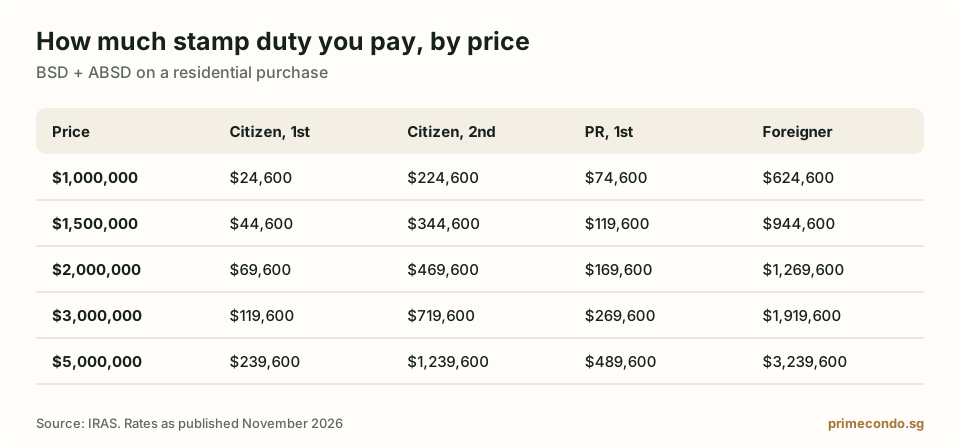
If you already own a home, or you are not a Singapore Citizen, Additional Buyer’s Stamp Duty is charged on top. And if you sell within four years, Seller’s Stamp Duty applies on the way out.
Frequently asked questions
How much is stamp duty on a $1.5 million condo?
Buyer’s Stamp Duty on a $1,500,000 home is $44,600. Any ABSD is added on top.
Is BSD different for foreigners?
No. BSD rates are the same for citizens, permanent residents and foreigners. Foreigners pay much more in total because of the 60% Additional Buyer’s Stamp Duty.
Can stamp duty be included in the home loan?
No. Banks lend against the property price or valuation only. Stamp duty must come from cash or CPF savings.
Is BSD charged on the price or the valuation?
On whichever is higher. If you pay above valuation, duty is on the price. If you buy below market value, for example from a family member, duty is on the market value.
Sources
This guide is general information, not tax, legal or financial advice. Rules change; check the official source before you commit.
Keep reading
ABSD in Singapore: rates, remissions and worked examples
Current ABSD rates for every buyer profile, how joint purchases are taxed, and the refund rules for married couples.
TaxesSeller’s Stamp Duty (SSD) in Singapore: rates and holding periods
The four-year SSD schedule, the older three-year schedule, and how to count your holding period.
BuyingHow to buy a condo in Singapore: step by step
From loan approval to collecting keys: the timeline, the paperwork and all the costs.