Key points
- ABSD is charged on the full purchase price, on top of Buyer’s Stamp Duty.
- Singapore Citizens pay 0% on a first home, 20% on a second and 30% on a third or later home.
- Permanent Residents pay 5%, 30% and 35%. Foreigners pay 60% on any home. Entities pay 65%.
- When buyers with different profiles buy together, the highest rate applies to the whole price.
- Married couples with at least one citizen spouse can get ABSD on a replacement home refunded if they sell the first home within 6 months.
Additional Buyer’s Stamp Duty (ABSD) is the tax that most shapes who buys what in Singapore. It was introduced in 2011 to cool demand, and has been raised several times since. The current rates took effect on 27 April 2023.
Current ABSD rates
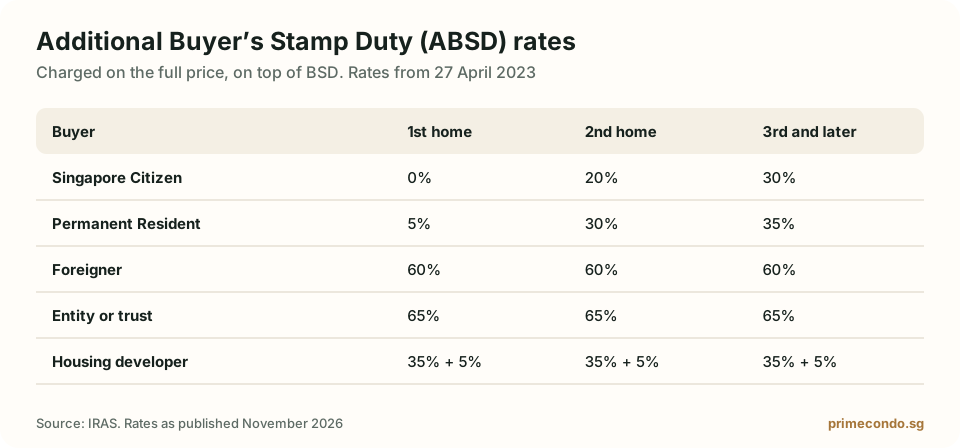
| Buyer | 1st home | 2nd home | 3rd and later |
|---|---|---|---|
| Singapore Citizen | 0% | 20% | 30% |
| Singapore Permanent Resident | 5% | 30% | 35% |
| Foreigner | 60% | 60% | 60% |
| Entity (company, association) | 65% | 65% | 65% |
| Trustee | 65% | 65% | 65% |
| Housing developer | 35% remittable + 5% non-remittable | same | same |
ABSD is charged on the purchase price or the market value, whichever is higher. It is calculated on the whole amount, not in bands, and is rounded down to the nearest dollar.
How ABSD is calculated
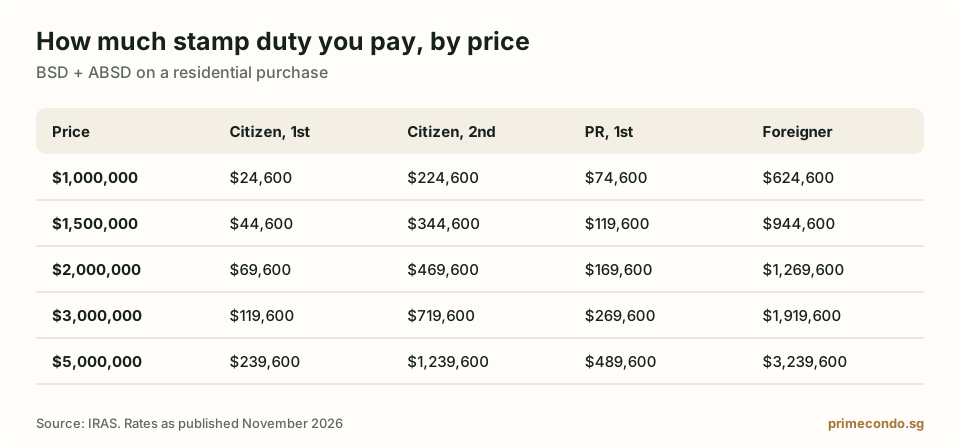
ABSD always comes on top of Buyer’s Stamp Duty. Take a $2,000,000 condo:
| Buyer | BSD | ABSD | Total duty |
|---|---|---|---|
| Citizen, first home | $69,600 | $0 | $69,600 |
| Citizen, second home | $69,600 | $400,000 | $469,600 |
| PR, first home | $69,600 | $100,000 | $169,600 |
| Foreigner | $69,600 | $1,200,000 | $1,269,600 |
How your property count is worked out
The rate depends on how many residential properties you own at the moment you sign for the new one.
- Any share counts as one property. Owning 1% of a flat with a parent counts the same as owning all of it.
- HDB flats count. So do condos, landed homes, and shophouses with permitted residential use.
- A purchase counts from the day the contract is signed, even before you collect the keys.
- Property held on trust counts for each identifiable beneficial owner.
- Overseas property does not count.
Buying with someone else
When co-buyers have different profiles, IRAS applies the highest rate among them to the entire price. A citizen who owns nothing and buys jointly with a foreigner pays 60%, not a blend.
The same logic applies to property counts. If one spouse already owns a home and the other owns none, a joint purchase is taxed as a second home.
ABSD remission for married couples
Two reliefs matter to most families. Both need at least one Singapore Citizen spouse.
Buying a first matrimonial home together. A citizen married to a PR or foreigner can get full ABSD remission on a jointly bought home, as long as neither spouse owns any other residential property.
Buying a replacement home before selling the first. A married couple with a citizen spouse must pay ABSD on the second home up front. They can then claim a refund if they sell the first home within 6 months of:
- the date of purchase, for a completed property, or
- the Temporary Occupation Permit or Certificate of Statutory Completion date, whichever is earlier, for a property still under construction.
The couple must not buy any other property in between, and the refund has to be claimed within 6 months of selling the first home.
Watch the cash flow. On a $2,000,000 replacement home, a citizen couple pays $400,000 in ABSD within 14 days and waits for the refund. Plan for that amount in cash, because it cannot be borrowed from a bank.
Free trade agreement nationals
Under free trade agreements, the following buyers pay the same ABSD as Singapore Citizens:
- Nationals and permanent residents of Iceland, Liechtenstein, Norway and Switzerland
- Nationals of the United States
They still need to meet the usual rules on what foreigners can buy. See Can foreigners buy property in Singapore?
How much ABSD is collected
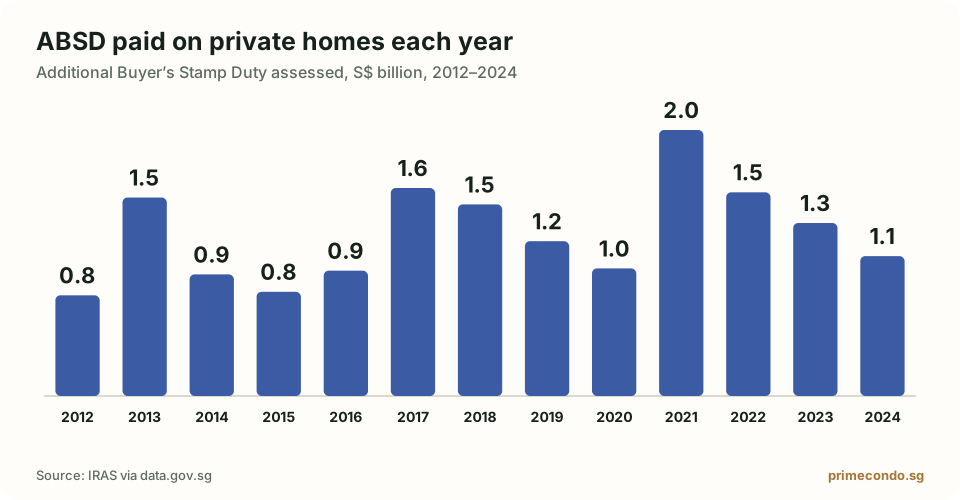
ABSD has become a significant source of revenue. The amount swings with how many second-home and foreign buyers are active in a given year.
Be careful with ABSD workarounds
Arrangements such as “99-to-1” purchases, where one spouse buys 99% and later sells 1% to the other, have been audited by IRAS as tax avoidance. Where IRAS finds avoidance it can recover the duty with a 50% surcharge. If someone proposes a structure that makes ABSD vanish, take independent legal advice before you sign.
Frequently asked questions
Do Singapore Citizens pay ABSD on their first property?
No. A Singapore Citizen who owns no other residential property pays no ABSD. Only Buyer’s Stamp Duty applies.
How much ABSD does a foreigner pay in Singapore?
Foreigners pay 60% ABSD on any residential property, whether it is their first or a later purchase. Nationals of the United States, and nationals and permanent residents of Iceland, Liechtenstein, Norway and Switzerland, are treated like Singapore Citizens under free trade agreements.
When must ABSD be paid?
Within 14 days of signing the contract, which for most buyers is the date you exercise the Option to Purchase or sign the Sale and Purchase Agreement. If the document is signed overseas, it is 30 days from when it is received in Singapore.
Does owning an HDB flat count as a property for ABSD?
Yes. HDB flats, condos, landed homes and partial shares in any of them all count. Overseas properties do not count.
Can I use CPF to pay ABSD?
You can use CPF Ordinary Account savings for stamp duty, but in most cases you must pay IRAS in cash first and then apply for reimbursement from your CPF account.
Sources
- IRAS: Additional Buyer’s Stamp Duty (ABSD)
- data.gov.sg: Stamp duty assessed for private residential properties
This guide is general information, not tax, legal or financial advice. Rules change; check the official source before you commit.
Keep reading
Buyer’s Stamp Duty (BSD) in Singapore: rates and how to calculate it
The six BSD bands, a shortcut formula, and exactly how much duty applies from $1 million to $5 million.
TaxesSeller’s Stamp Duty (SSD) in Singapore: rates and holding periods
The four-year SSD schedule, the older three-year schedule, and how to count your holding period.
BuyingCan foreigners buy property in Singapore?
What foreigners can buy, the 60% ABSD, who is exempt under free trade agreements, and how loans work.