Key points
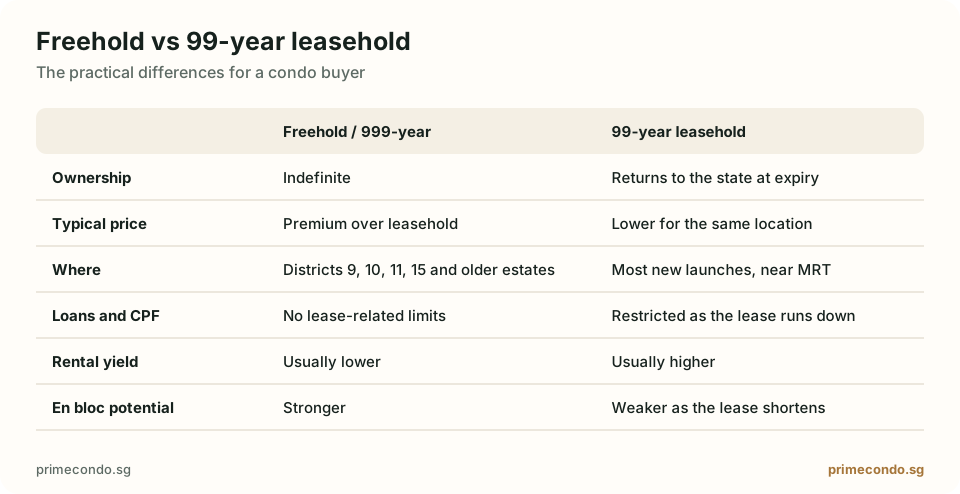
- Freehold means you own the land indefinitely. A 99-year lease returns to the state when it ends.
- 999-year leasehold is treated the same as freehold in practice.
- Freehold condos usually cost more than comparable leasehold condos in the same area.
- CPF use is restricted when the remaining lease cannot cover the youngest buyer to age 95, and banks lend less on short leases.
- For a holding period of 10 to 15 years, location and entry price usually matter more than tenure.
Tenure is one of the first filters buyers apply, and one of the most misunderstood. Freehold sounds obviously better. Whether it is worth paying for depends on how long you will hold the property and what you are giving up to get it.
The three tenures
- Freehold: you own the land outright, with no end date.
- 999-year leasehold: a lease so long it is treated as freehold by buyers and banks.
- 99-year leasehold: the standard tenure for land sold by the government. When the lease ends, the property returns to the state.
Price
Freehold condos generally sell at a premium to comparable 99-year condos nearby. The size of the premium varies widely with age and location, and a brand-new leasehold project often costs more per square foot than a 20-year-old freehold one next door, because buyers pay for newness too.
That is why a like-for-like comparison is hard. Always compare against recent transactions for developments of similar age in the same area.
How a 99-year lease loses value
A lease does not lose value in a straight line. For the first few decades, age matters far more than the lease itself, and many leasehold condos appreciate strongly in that time. The decline becomes more noticeable as financing gets harder:
- Remaining lease below about 60 years: fewer buyers qualify for full financing, and prices start to reflect it.
- Remaining lease cannot cover the youngest buyer to age 95: CPF usage is pro-rated.
- Remaining lease below 30 years: bank loans are very hard to obtain.
- Remaining lease 20 years or less: CPF cannot be used at all.
Each threshold shrinks the pool of people who can buy your unit. That, more than the expiry date itself, is what drives prices down late in a lease.
Financing and CPF rules
CPF Ordinary Account savings can be used up to the property’s Valuation Limit if the remaining lease covers the youngest buyer until at least age 95. A 35-year-old needs 60 years left on the lease. If the lease falls short, the amount of CPF you can use is reduced proportionately.
Banks set their own lending policies for older leases and generally want a meaningful buffer of lease remaining at the end of the loan. If you are considering a leasehold condo more than 30 years old, check with a bank before you pay an option fee.
Rental yield
Tenants do not pay more for freehold. They pay for location, condition and facilities. Since a leasehold unit costs less to buy and rents for about the same, leasehold condos usually have higher gross rental yields. Compare rents by project on our rental prices page.
Collective sales
When an older development is sold en bloc to a developer, freehold land is worth more because the developer does not have to pay the state to top up the lease. Freehold owners in ageing estates therefore have a stronger exit route. A collective sale needs the consent of owners holding at least 80% of share values and strata area for developments 10 years or older, and it can take years with no guarantee of success.
Where each is found
Freehold land is concentrated in the older private estates: District 9, District 10, District 11 and District 15, with pockets in Districts 12, 14 and 19. Nearly all sites sold through Government Land Sales are 99-year, which is why most new launches next to MRT stations are leasehold.
How to decide
- Holding for 10 to 15 years, or buying to rent out? A newer 99-year condo in a strong location is often the more efficient choice.
- Buying a home to keep for decades or pass on? Freehold removes lease decay from the equation.
- Buying an older leasehold unit? Work out how much lease will remain when you expect to sell, and who will be able to finance it then.
Frequently asked questions
Is freehold always a better investment than leasehold?
No. Freehold holds value better over the very long term, but a well-located new 99-year condo near an MRT station can outperform an older freehold condo in a weaker location, particularly over the first 10 to 20 years of the lease.
What happens when a 99-year lease expires?
The land and everything on it returns to the state without compensation. Owners can apply to top up the lease by paying a premium, but approval is at the government’s discretion and has been rare for residential sites.
Can I use CPF to buy an old leasehold condo?
You can use CPF in full only if the remaining lease covers the youngest buyer until age 95. If it does not, the amount of CPF you can use is pro-rated. CPF cannot be used at all if the remaining lease is 20 years or less.
Where are most freehold condos in Singapore?
Mainly in older private estates: Districts 9, 10 and 11 in the centre, District 15 in the east, and pockets of Districts 12, 14, 19 and 21. Most land sold by the government since the 1960s has been on 99-year leases.
Sources
This guide is general information, not tax, legal or financial advice. Rules change; check the official source before you commit.
Keep reading
New launch vs resale condo: which should you buy?
Payment schedules, price per square foot, space and risk compared side by side.
MarketCCR, RCR and OCR explained: Singapore’s three property regions
Which districts are prime, city fringe or suburban, and how prices in each have moved since 2009.
BuyingHow to buy a condo in Singapore: step by step
From loan approval to collecting keys: the timeline, the paperwork and all the costs.