Key points
- New launches are paid in stages during construction, so your loan repayments start small and grow.
- Resale condos need the full 25% downpayment up front but can be lived in or rented out immediately.
- New launches usually cost more per square foot and have smaller units than older resale condos.
- The Seller’s Stamp Duty clock starts when you sign, so construction time counts towards the four-year holding period.
- With a resale unit you can inspect the actual home, the view and the neighbours before you buy.
Every condo buyer in Singapore has to choose between a brand-new unit bought off-plan from a developer and an existing unit bought from an owner. Neither is better in general. They suit different finances and different plans.
At a glance
| New launch | Resale | |
|---|---|---|
| Payment | In stages over 3 to 4 years | 25% down, loan in full at completion |
| Move in or rent out | After construction | About 3 months after you commit |
| Price per sq ft | Higher | Lower for the same location |
| Unit size | Smaller, efficient layouts | Often larger, especially pre-2010 |
| What you see | Showflat and floor plan | The actual unit, view and estate |
| Condition | New, with 12-month defects period | Varies; may need renovation |
| Lease | Fresh 99 years or freehold | Shorter remaining lease if leasehold |
| Price negotiation | Fixed price list, some discounts | Negotiable with the owner |
How new launch payments work
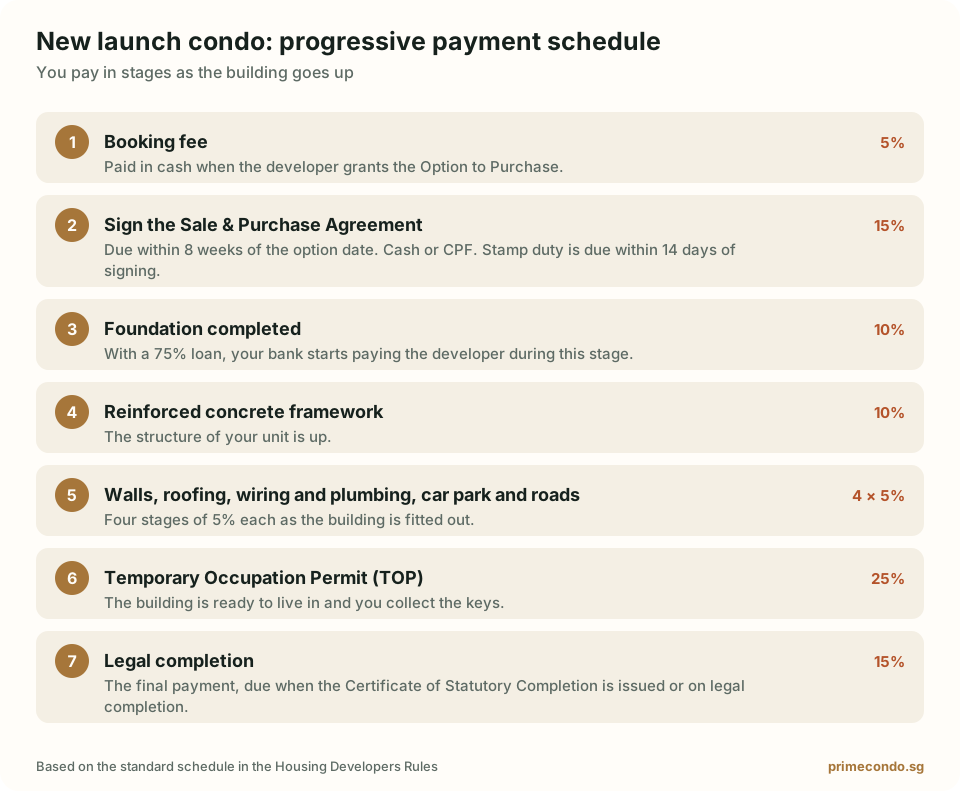
This staged schedule is the main financial attraction of a new launch. Because the bank only releases money as each stage is reached, your monthly repayment starts low and rises as the building goes up. For the first year or so you may be servicing less than a third of the eventual loan.
That helps buyers who are still paying rent or another mortgage. The trade-off is that you pay for several years without having a home to live in or let.
How resale payments work
With a resale unit, you pay 5% on exercising the option and the remaining 20% of the downpayment at completion, when the full loan is also drawn down. Repayments begin at the full amount straight away, but so does your use of the property.
For an investor, a resale unit can be tenanted from day one. Check achievable rents by project on our condo rental prices page before you make an offer.
Price and space
New launches are priced on today’s land and construction costs, so they nearly always cost more per square foot than older neighbours. To keep the total price manageable, developers build smaller units.
An older resale condo will typically give you more floor area for the same money, and often a larger land plot with more generous grounds. The costs are an older lease if the development is leasehold, higher maintenance as the building ages, and renovation.
What the market looks like now
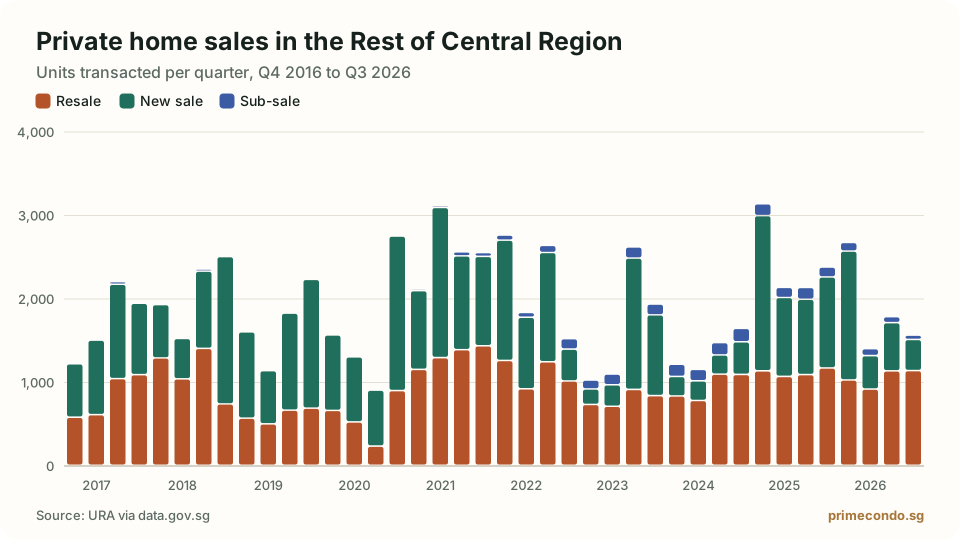
In Q3 2026, buyers in the Core Central Region bought 297 new units from developers and 677 resale units. In the Outside Central Region the figures were 514 new and 1,990 resale.
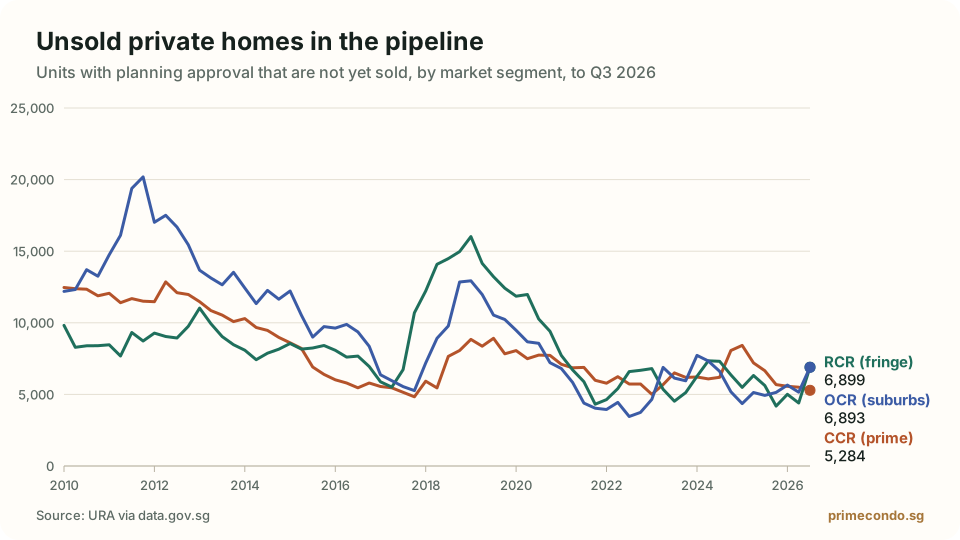
Developers also held 19,076 unsold private homes with planning approval across Singapore at the end of Q3 2026. When unsold stock is high, developers have more reason to offer discounts.
Risk
- New launch: You are buying from plans. The finished view, noise and build quality can differ from what you imagined, and the market may move during construction. On the other hand, Seller’s Stamp Duty counts from the date you sign, so much of the four-year holding period has passed by the time you get the keys.
- Resale: What you see is what you get, but check for upcoming special levies, the state of the sinking fund and how the remaining lease affects financing. See Freehold vs 99-year leasehold.
Which suits you?
A new launch tends to suit buyers who do not need to move soon, want lower payments in the early years, or value a fresh lease and new facilities.
A resale condo tends to suit buyers who need a home now, want more space for the money, want rental income immediately, or want to inspect exactly what they are buying.
Either way, start with the step-by-step buying guide and confirm your budget with the affordability calculator.
Frequently asked questions
Is it cheaper to buy a new launch or a resale condo?
Resale condos are usually cheaper per square foot than new launches in the same area, and older units tend to be larger. New launches cost more but come with a new lease, modern facilities and lower maintenance needs in the early years.
What is the progressive payment scheme?
It is the standard payment schedule for uncompleted private homes. You pay 5% on booking, 15% within 8 weeks, then stages of 5% to 10% as construction progresses, 25% when the Temporary Occupation Permit is issued and the final 15% on completion.
Can I rent out a new launch condo immediately?
Only after it is completed and you receive the keys, which is typically three to four years after launch. A resale condo can be rented out as soon as the purchase completes.
What happens if the developer goes bust?
Payments for uncompleted homes go into a project account that can only be used for that development’s construction and related costs. Singapore’s rules reduce the risk considerably, but they do not remove it, so buyers still favour developers with a track record.
Sources
This guide is general information, not tax, legal or financial advice. Rules change; check the official source before you commit.
Keep reading
How to buy a condo in Singapore: step by step
From loan approval to collecting keys: the timeline, the paperwork and all the costs.
BuyingFreehold vs 99-year leasehold condos in Singapore
What tenure really changes: price, loans, CPF limits and what happens as a lease runs down.
TaxesSeller’s Stamp Duty (SSD) in Singapore: rates and holding periods
The four-year SSD schedule, the older three-year schedule, and how to count your holding period.