Key points
- Banks lend up to 75% of the price for a first housing loan, 45% for a second and 35% for a third.
- Your total monthly debt repayments cannot exceed 55% of gross monthly income (TDSR).
- Banks test your loan at an interest rate of at least 4%, even if the actual rate is lower.
- At least 5% of the price must be cash; the next 20% can be cash or CPF.
- Stamp duty is on top of the downpayment and cannot be borrowed.
Your condo budget in Singapore is set by three separate limits. You can only buy what satisfies all three, so the lowest one is your ceiling.
Limit 1: Loan-to-value (LTV)
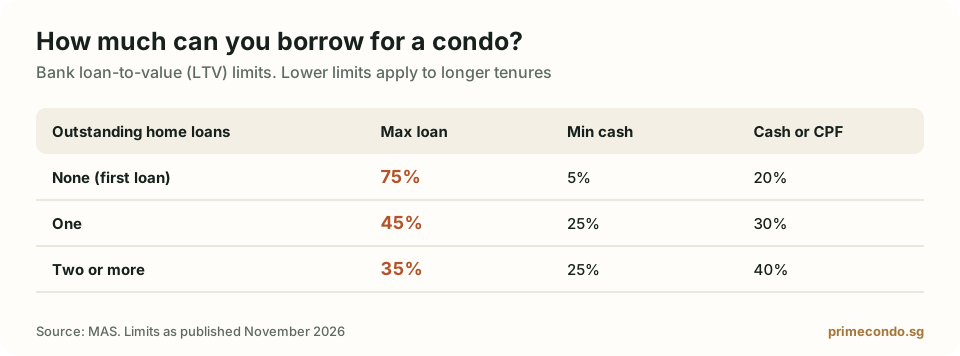
The Monetary Authority of Singapore caps how much a bank can lend against a home. The cap depends on how many housing loans you already have.
| Outstanding housing loans | Maximum loan | Minimum cash | Remainder (cash or CPF) |
|---|---|---|---|
| None | 75% | 5% | 20% |
| One | 45% | 25% | 30% |
| Two or more | 35% | 25% | 40% |
These limits assume a loan tenure of 30 years or less that ends by the time you are 65. For longer tenures the caps fall to 55%, 25% and 15%, and the minimum cash on a first loan rises to 10%.
The percentage is applied to the purchase price or the bank’s valuation, whichever is lower. If you agree to pay more than the valuation, the difference must be in cash.
Limit 2: Total Debt Servicing Ratio (TDSR)
TDSR caps all your monthly debt repayments at 55% of gross monthly income. That includes the new mortgage, car loans, student loans, personal loans and the minimum payment on credit card balances.
Two details catch buyers out:
- The stress-test rate. For TDSR, the bank calculates your mortgage instalment at 4% a year or the actual loan rate, whichever is higher. A cheap promotional rate does not increase how much you can borrow.
- Haircuts on income. Variable income such as commission and bonuses, and rental income, is counted at 70%.
What your income supports
Assuming no other debts and a 30-year tenure:
| Gross monthly income | Max monthly debt (55%) | Maximum loan | Price at 75% LTV |
|---|---|---|---|
| $8,000 | $4,400 | $921,000 | $1,228,000 |
| $12,000 | $6,600 | $1,382,000 | $1,842,667 |
| $16,000 | $8,800 | $1,843,000 | $2,457,333 |
| $20,000 | $11,000 | $2,304,000 | $3,072,000 |
| $30,000 | $16,500 | $3,456,000 | $4,608,000 |
Existing debts reduce this quickly. A $1,200 monthly car loan cuts the maximum home loan by about $251,000.
Limit 3: Cash and CPF
Even if the loan is approved, you need the downpayment and stamp duty ready.
| Price | Min cash (5%) | Cash or CPF (20%) | Buyer’s Stamp Duty | Loan (75%) | Income needed |
|---|---|---|---|---|---|
| $1,200,000 | $60,000 | $240,000 | $32,600 | $900,000 | $7,900 |
| $1,600,000 | $80,000 | $320,000 | $49,600 | $1,200,000 | $10,500 |
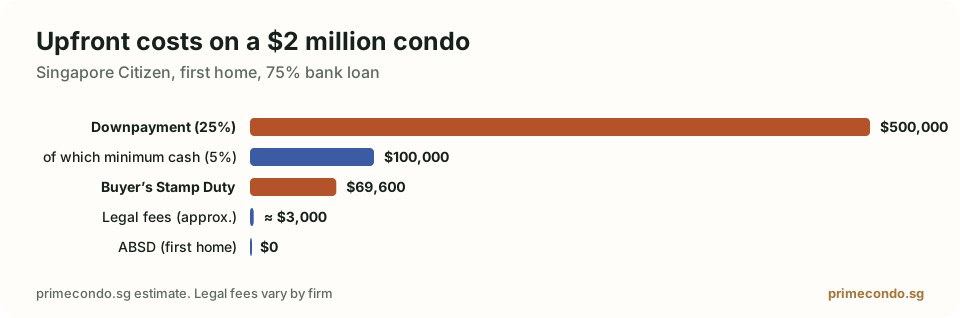
| $2,000,000 | $100,000 | $400,000 | $69,600 | $1,500,000 | $13,100 |
| $3,000,000 | $150,000 | $600,000 | $119,600 | $2,250,000 | $19,600 |
“Income needed” is the gross monthly household income that passes TDSR with no other debts, for a Singapore Citizen buying a first home. If ABSD applies to you, add it to the cash you need.
Using CPF
CPF Ordinary Account savings can pay for the downpayment above the minimum cash, the monthly instalments and stamp duty. Three things to know:
- You repay CPF with interest when you sell. The principal you used plus accrued interest goes back into your own account from the sale proceeds.
- There are usage limits based on the purchase price or valuation, and stricter ones for homes with shorter leases. See Freehold vs leasehold.
- Foreigners have no CPF, so the whole downpayment must be cash.
Ways to raise your budget, and their costs
- Clear other debts first. Paying off a car loan can raise your home loan by more than the amount repaid.
- Add a co-borrower. Combined incomes count, but so do combined debts, and the co-borrower’s property count affects ABSD if they are also a co-owner.
- Pledge or show assets. Banks can count a portion of pledged deposits or liquid assets as income.
- Pay a larger downpayment. It reduces the loan needed to pass TDSR.
Stretching to the absolute limit leaves no room for rate rises or a drop in income. Many buyers choose to stay comfortably below the 55% line.
Frequently asked questions
What income do I need to buy a $2 million condo?
With a 75% loan of $1.5 million over 30 years, tested at 4%, the monthly instalment used for TDSR is about $7,160. With no other debts, that needs a gross monthly household income of roughly $13,000.
What is the maximum home loan tenure in Singapore?
35 years for private property. However, if the tenure is more than 30 years, or runs past age 65, the maximum loan drops from 75% to 55% of the price for a first housing loan.
Does TDSR apply to foreigners?
Yes. TDSR and loan-to-value limits apply to all borrowers from financial institutions in Singapore, regardless of nationality.
Can I use CPF for the downpayment?
Yes, for the part above the minimum cash. With a 75% loan, 5% must be cash and the remaining 20% can come from your CPF Ordinary Account.
Sources
This guide is general information, not tax, legal or financial advice. Rules change; check the official source before you commit.
Keep reading
How to buy a condo in Singapore: step by step
From loan approval to collecting keys: the timeline, the paperwork and all the costs.
TaxesBuyer’s Stamp Duty (BSD) in Singapore: rates and how to calculate it
The six BSD bands, a shortcut formula, and exactly how much duty applies from $1 million to $5 million.
TaxesABSD in Singapore: rates, remissions and worked examples
Current ABSD rates for every buyer profile, how joint purchases are taxed, and the refund rules for married couples.