Key points
- Homes bought on or after 4 July 2025: SSD of 16%, 12%, 8% and 4% if sold in years one to four.
- Homes bought between 11 March 2017 and 3 July 2025: 12%, 8% and 4% if sold in years one to three.
- SSD is charged on the selling price or market value, whichever is higher, not on your profit.
- The schedule that applies is fixed by your purchase date and does not change later.
- After the holding period ends, no SSD is payable.
Seller’s Stamp Duty (SSD) is a tax on selling a home soon after buying it. It exists to discourage flipping. On 4 July 2025 the government lengthened the holding period from three years to four and raised every rate by four percentage points.
SSD rates
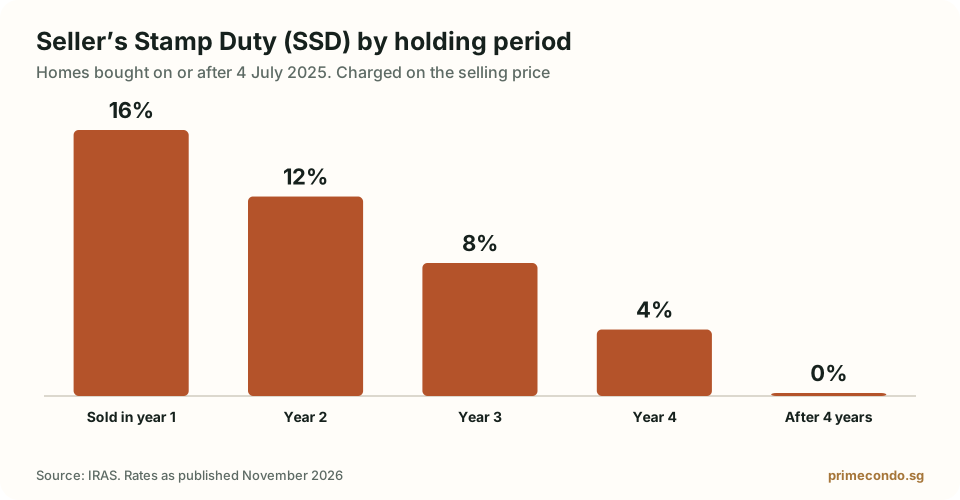
| When you sell | Bought 11 Mar 2017 – 3 Jul 2025 | Bought on or after 4 Jul 2025 |
|---|---|---|
| Within 1 year | 12% | 16% |
| More than 1 and up to 2 years | 8% | 12% |
| More than 2 and up to 3 years | 4% | 8% |
| More than 3 and up to 4 years | None | 4% |
| More than 4 years | None | None |
Which column you fall in depends on when you bought. There was no transition period: if your Option to Purchase was exercised on or after 4 July 2025, the four-year schedule applies, even if the option was granted earlier.
How the holding period is counted
The clock starts on the date you acquired the property and stops on the date you dispose of it. In most cases:
- Start: the date you exercised the Option to Purchase, or signed the Sale and Purchase Agreement for a new launch.
- End: the date your buyer exercises the option you granted.
For a new launch, this means the holding period starts years before you get the keys. A buyer who signs in 2026 for a condo completing in 2029 will be most of the way through the four years by the time the unit is ready.
Worked example
You sign for a resale condo on 1 September 2025 for $1,800,000, and sell it on 1 March 2027 for $1,900,000.
- Holding period: 18 months, which falls in the second year
- Rate: 12% (purchase was after 4 July 2025)
- SSD: 12% × $1,900,000 = $228,000
Your gain on paper was $100,000, but the SSD alone is more than twice that. Add the Buyer’s Stamp Duty paid on entry and the sale produces a large loss. That is the intended effect.
What SSD is charged on
SSD is charged on the selling price or the market value, whichever is higher. It is not a tax on gains. Selling at a loss does not reduce it, and transferring a share to a family member below market value does not avoid it.
Planning around SSD
- Treat four years as the minimum horizon. If there is a real chance you will need to sell sooner, for example a job posting abroad, factor the SSD into your decision before you buy.
- Renting out is not a disposal. If your plans change, letting the home until the holding period ends avoids the duty. Check what condos rent for in your district first.
- New launches give you a head start. Construction time counts towards the holding period. See New launch vs resale.
Frequently asked questions
How long must I hold a property to avoid SSD?
Four years if you bought on or after 4 July 2025. Three years if you bought between 11 March 2017 and 3 July 2025.
Is SSD charged on profit?
No. SSD is a percentage of the selling price or market value, whichever is higher. It is payable even if you sell at a loss.
Does SSD apply to HDB flats?
The SSD schedule applies to all residential property, including HDB flats. In practice HDB’s five-year Minimum Occupation Period is longer than the SSD holding period, so most HDB sellers are not affected.
Who pays SSD and when?
The seller pays, within 14 days of the date the sale contract is signed. For most sales that is the day the buyer exercises the Option to Purchase.
Sources
This guide is general information, not tax, legal or financial advice. Rules change; check the official source before you commit.
Keep reading
ABSD in Singapore: rates, remissions and worked examples
Current ABSD rates for every buyer profile, how joint purchases are taxed, and the refund rules for married couples.
TaxesBuyer’s Stamp Duty (BSD) in Singapore: rates and how to calculate it
The six BSD bands, a shortcut formula, and exactly how much duty applies from $1 million to $5 million.
BuyingNew launch vs resale condo: which should you buy?
Payment schedules, price per square foot, space and risk compared side by side.